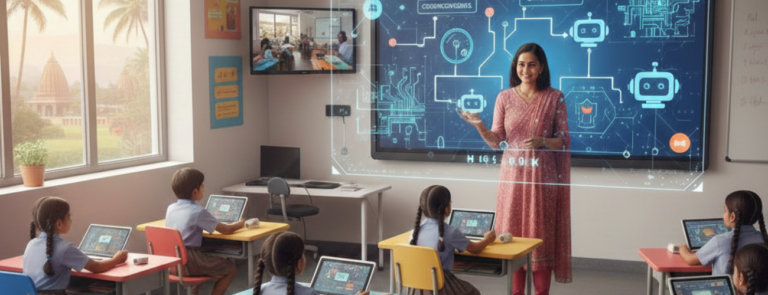

A visual guide to how Class 3 students will learn to solve problems using the new CBSE AI & CT framework
The New Era: AI & Coding in CBSE Class 3
For the first time, coding and AI are moving from optional high school subjects to foundational skills for primary students. Under the National Education Policy (NEP) 2020 and the National Curriculum Framework (NCF) 2023, students will now spend approximately 50 hours per year on Computational Thinking and AI literacy.
1. What is the Goal? (The “Why”)
The Ministry of Education isn’t trying to make every child a software engineer by age nine. Instead, the focus is on:
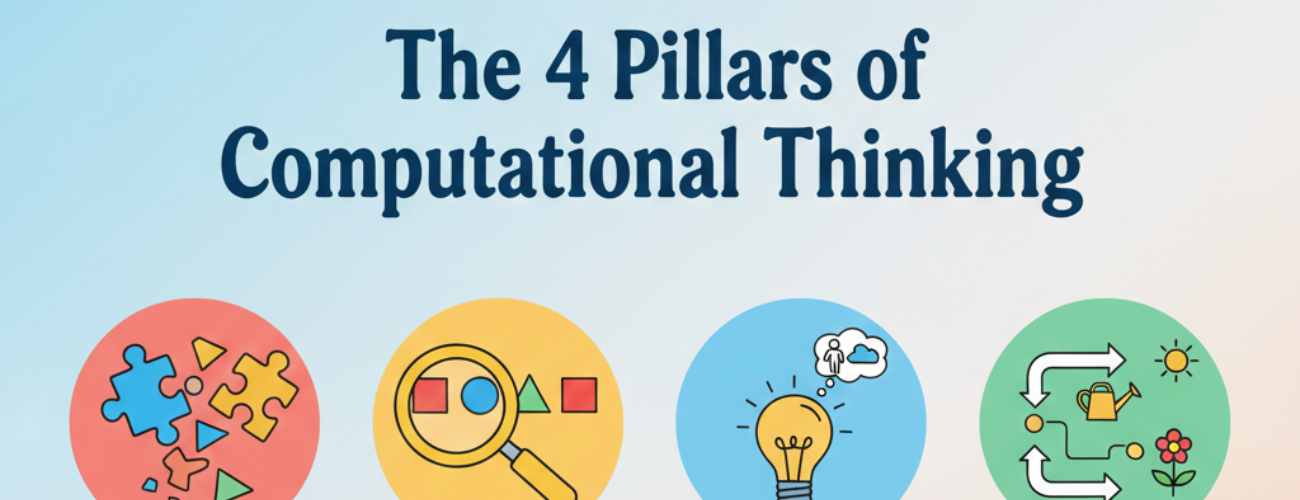
- Computational Thinking (CT): Learning to break down complex problems into small, manageable parts (Decomposition).
- Pattern Recognition: Finding similarities in information to predict what happens next.
- AI for Public Good: Teaching children to use technology ethically—for example, thinking about how AI can help reduce waste or save water.
2. Core Syllabus Topics for Class 3
The syllabus is designed to be “unplugged” (offline) and “plugged” (online), making it accessible even to schools with limited tech.
| Module | What Kids Will Learn |
| Foundations of Coding | Understanding sequences (step-by-step instructions) and algorithms using daily life examples like recipes or morning routines. |
| Logic & Reasoning | Puzzles and games that teach “If-Then” logic (e.g., If it rains, then take an umbrella). |
| Visual Block Coding | Using tools like Scratch or PictoBlox to drag and drop “blocks” of code to move a character or play a sound. |
| Introduction to AI | Learning how machines “see” faces (Face Detection) and “hear” voices through simple, interactive AI games. |
| Physical Computing | Basic understanding of sensors and buttons—how a light turns on when you press a switch. |
3. How Will It Be Taught?
Classes won’t just be about staring at screens. The CBSE expert committee, led by Prof. Karthik Raman (IIT Madras), emphasizes:
- Storytelling & Role-play: Using stories to explain fairness and bias in AI.
- Interactive Puzzles: Solving logic puzzles with crayons and paper to build mental models of algorithms.
- Integrated Learning: AI won’t be a separate boring period. It will be taught through Mathematics and Environmental Studies (EVS).
4. Recommended Tools for Parents & Teachers
If you want to give your child a head start at home, these are the platforms most aligned with the 2026 CBSE goals:
- Scratch / ScratchJr: The gold standard for block-based creative coding.
- PictoBlox: Excellent for introducing AI and Robotics using blocks.
- Blockly Games: A Google-backed platform that teaches logic through puzzles.
- Code.org: Offers the “Hour of Code” which is highly popular in Indian schools.
About The Author